Friday, August 8, 2025

Data View: Smarter than Your Average Hamster


Fellow hamsters, if it felt like you were running faster or maybe smarter on the old exercise wheel in your cage last quarter, you were, according to the U.S. Bureau of Labor Statistics.  The question is how many hamsters survived to enjoy the workout.

 The BLS reported Thursday that nonfarm business sector labor productivity increased a seasonally adjusted annualized 2.4 percent in the second quarter of 2025, as output increased 3.7 percent and hours worked increased 1.3 percent.  That was up from a revised productivity decrease of 1.8 percent in the first quarter.

 And the average hamster was getting somewhere, too. Adjusted for consumer prices, real hourly compensation increased an annualized 2.3 percent in the second quarter.  Real compensation was up 1.4 percent over the last four quarters through 2Q25.

 Meanwhile, unit labor costs, that is, the ratio of hourly compensation to productivity growth rates, increased an annualized 1.6 percent in the second quarter, a slowdown from the four quarters rate of 2.6 percent, good news for businesses that will have to deal with higher costs from other inputs due to Trump’s tariffs.

 Now, productivity growth is hailed as key to how the working stiff like your correspondent and his fellow hamsters get ahead of the game in this vale of tears.  But the problem, as we see it, is that productivity gains from fewer hamsters would be a recipe for social unease and a reason to keep the cork in the champagne.  The sharp downward revisions to May and June payrolls reported last week point to a disconnect in the relationship between rising productivity and a tide lifting all boats.

 We think the second quarter productivity and payroll numbers could reflect the first ripple of the artificial intelligence revolution that is about to reinvent work and likely replace a lot of us.

 Also on the labor front, weekly initial jobless claims increased 7,000 to a seasonally adjusted 226,000, the highest in a month.  More telling, perhaps, was news that continuing claims rose 38,000 to 1.974 million, the highest since November 2021, an indication that finding a new hamster cage is getting tougher.


Tuesday, August 5, 2025

From Unicorn to Antlers

 It wasn’t too long ago that the unicorn of a soft landing. i.e., puncture of the post-Covid inflation bubble without a punishing recession, hove into view.  But now that we take a closer look, we espy a different beast, this one with antlers we might call the horns of a dilemma – stagflation.

 That brewing outcome was reinforced this morning with news from the Institute for Supply Management that its services purchasing managers index ticked down to 50.1 in July from 50.8 in June.  A survey of economists polled by Reuters had expected a rise to 51.8.  A reading above 50.0 indicates economic expansion, so the new index reading hints at a U.S. economy close to stall speed.

 The report comes on the heels of the July jobs data from the Bureau of Labor Statistics, showing only 73,000 net jobs creation and sharp downward revisions to May and June numbers.  The orange Florida man fired the BLS director after the release of the news on Friday.  It will be fascinating to see what the bureau releases next month and whether financial markets believe it.

Meanwhile, we’ll be watching next week’s consumer price index for July from the same BLS that the Florida man says is rigging numbers to make him look bad.


Monday, August 4, 2025

Fed View: Freshly Squeezed or Concentrate?

 If the orange Florida man is smart – a dubious proposition that – he’ll take a page from Ronald Reagan’s tenure and leave monetary policy to the sous chefs  at the Fed, who, under chairman Paul Volcker, squeezed the stagflation orange dry, tipping the economy into recession at the beginning of Reagan’s first term and unemployment reached double digits. Your correspondent remembers the increasing appearance of Michigan license plates dotting the roads of the Sunbelt capital he resided in then.

The Volcker grip on the money supply did its job, though. Economic health followed and Reagan reaped the hosannas that prosperity evokes.  So could Trump.

But if this orange isn’t exactly plump with juicy irony (much too generous a description for unintended consequences that follow from obtuseness), it does sit pretty much in the bowl of damned-if-you-squeeze, damned-if-you-don’t after Friday’s employment data dump from the Bureau of Labor Statistics and the dumping of its Cassandra, BLS director Erika McEnrtarfer, who Trump accused of rigging the numbers.

The report surprised analysts with weaker than expected job growth in July and sharp downward revisions to May and June job market descriptions, ostensibly setting up the Federal Open Market Committee to deliver on Trump’s artless demand of Fed Chariman Jay Powell that interest rates be cut.

But hold on.  Trump says the jobs data were cooked to embarrass him and that the real statistics should show a robust labor market, which would, of course, call for the Fed to stick to its current stance. What to make of future employment reports, easily the most closely followed of government economic statistics, if  you can’t trust whoever Trump installs?  How can bond vigilantes punish or reward in real time if the time isn’t real?  For the record, U.S. government securities yields were marginally higher early Monday.

Now, the Fed was already behind the eight ball because inflation, which had declined but leveled off in recent months, could be lurking in the tariff declarations of Mr. Trump accompanied by near stall speed economic growth – the stagflation backdrop that Volcker faced in the 1980s.

We suspect the stock market will care little for now, its participants apparently believing that Trump’s vicissitudes matter little in the real world. But that real world also includes valuations that are exceedingly rich, whether measured by market cap to GDP or forward price-to-earnings ratios.  This more than Trump’s antics could dim enthusiasm.


(Note to our readers:  We have been silent for far too long and though the pleas for the return of The Donovan Report have been less than deafening, we intend to weigh in on a more less frequent basis in these interesting times.)

Thursday, April 16, 2020

Nasty, Brutish, and Not so Short

First published March 20, 2020, at TalkMarkets.com

Once I built a railroad, I made it run
Made it race against time
Once I built a railroad, now it's done
Brother, can you spare a dime?…
(lyricist E. Y. "Yip" Harburg,and composer Jay Gorney1930 )
Get ready, gentle reader, for numbers “like you’ve never seen them before,” in the favored phraseology of our supreme idiot, er, leader. 
Something tells us we are about to enter the 1930s in the 2020s. We used to wonder how our parents, grandparents and great-grandparents survived the Great Depression. You know who we’re talking about, the greatest generation. Walter Cronkite (look him up), our nation turns its lonely eyes to you.
Goo goo g’joob.
No more “OK, Boomer,” all right?  We’re all gonna get a dose of it.
Nine-eleven left your correspondent with memories of neckties and skirts flapping in the wind, trying to escape from an attack by members of their own species descended from the same Abrahamic source of God’s revelation. We don’t mean to be flip, but we’re inclined to agree with the Episcopal bishop in “Caddyshack” who exclaimed to Judge Smails the day after what would have been his record-setting putt popped out, “There is no God!”
Of course, there is. (We can discuss this later; His ways are mysterious).  In the meantime, prepare for that mysterious thing called uncertainty, which what all the market pundits (we among them) say plague investment decisions from cash to snake oil.
The equity and credit markets decide how to toggle between assets on real numbers from a central government that they assume is competent.  Can we trust a government that won’t nationalize the continent’s resources to whip it now? (apologies to Devo - look it up, generations x,y,z, et al.).
As we discussed in “Two Ex-Wives and Several Bartenders”, stocks are only for insiders at this point.  Either you sold like Sen. Richard Burr, (R-NC) did, or, like most of us, you scampered along as if all would all go according to plan. Talk about rigged. Oh, Doctor Evil, why didn’t you listen to Scott!
No one should be in stocks unless he/she knows something the world doesn’t. The lows are not in. Welcome to the Hobbesian world of buying the dips: nasty, brutish and short.
We Irishmen know life is not fair, but at some point, our brave forbearer stopped digging rotten potatoes and got to the USA.  Level the playing field while you can.  Await the $1,200-whatever check that won’t pay a month’s rent in Brooklyn, and tip your bartender if you can still see her again face to face.
Welcome to the Hobbesian world of buying the dips: nasty, brutish and short. 

Friday, March 20, 2020

Two Ex-Wives and Several Bartenders

(Originally published at Talkmarkets.com on March 18, 2020)

As we compose this, gentle reader, we are coughing and achy, but no fever or foreign travel, so the public authorities here in Dixie waved us on and didn’t swab our bodily fluids because, we suspect, they don’t have enough tests to waste on, let’s say, senior sorta guys who look like they can limp along for a little while longer. Or, more depressing, they harbor the unspoken thought that guys like us – and we have to glumly agree – are no big loss. No worries.  Still taking in plenty of oxygen between Marlboros.
In any event, as we warned in “The Great Fires of 2020”, “the world is due for something to blow up.” And so it has. Much has been made of the overused “black swan” to explain the equity market meltdown, which is true as far as it goes.
A worldwide recession, if not depression, is certainly baked in the COVID-19 cake.  Indeed, this is one of the easiest episodes for the financial reporter to tell her readers why the market soufflĂ© has collapsed.  But there’s another ingredient in this not-so-secret recipe: stocks were just too damn rich.  Getting into our way-back machine, the ratio of market capitalization to gross domestic product was about 152% at the end of 2019.  At the close March 16, the ratio was 110%, suggesting stocks are near fair value.  Of course, the denominator in this fraction will be getting smaller as well; thus, stocks may still not be a bargain measured by the resized economic pie.
So don’t be satisfied it’s safe to buy stocks. Get out now: We’re doomed. As we heard some expert or another characterize the pandemic’s ultimate outcome, we’ll either get immunity or die. So we have that going for us. After all, the 10-year Treasury note yield at this writing is at 1.038%. It began the day at 0.78%. What a world! Still, one would have netted about 190% in price gain if she had followed our advice to buy at 3%, not to mention the raise she could get by refinancing that big old mortgage.
We anticipate your riposte: A stopped clock is right twice a day. And that’s a fair criticism of equity perma bears like us. Yet we still insist stocks are only for those willing to believe they are smarter than Mother Nature. (And, to be fair again, there are those among us who can see what we cannot see. The rich are different than you and us).
But if you are not one of the one-percent, we are reminded of Cary Grant’s character in “North by Northwest” telling government agents: “I've got a job, a secretary, a mother, two ex-wives and several bartenders that depend upon me, and I don't intend to disappoint them all by getting myself ‘slightly’ killed.”  We don’t either, gentle reader.
What to expect? 
  • The Federal Reserve Board’s ability to keep financial markets liquid remains formidable. At the first sign credit markets were seizing up, as fixed-income and equity sectors fell in tandem, the Fed stepped in and righted the bond-stock relationship. It can succeed in this respect, but cannot defeat the lack of ventilators or the coronavirus grapes of wrath.
  • The unemployment rate will reach double digits in next month’s employment report in March.
  • The United States will not shut down like Italy. Americans are too restless, too diverse.
  • If you must buy stocks, we recommend Amazon, which will rule the world once the dust settles. And pick an airline. The industry will be bailed out.
  • Budget a $1,000 or more check in the mail in the next 30 days. Don’t spend it all in one place.

Sunday, January 26, 2020

Data Briefing: How 'Real' Are Retail Sales?

Merrily, we roll along.
Data released this morning support the sense that the U.S. economy remains buoyant.  We wonder though.
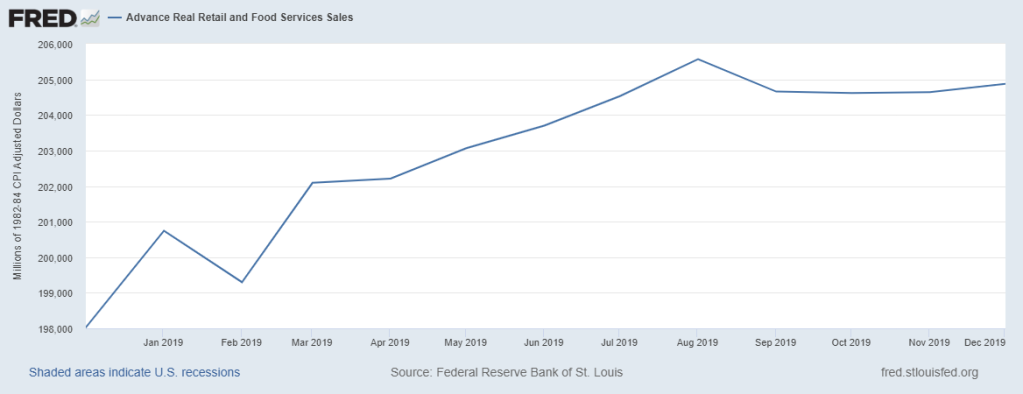
Let’s get to the headline: the U.S. Census Bureau reported that retail sales rose 0.3% in December and up 5.8% from December 2018. 
It is curious to us, though, that the headline figure from the Census Bureau is adjusted for seasonal variation but not inflation.  Using the consumer price index as a deflator, the St. Louis Fed figures show just a 0.1% increase in retail sales in December from the previous month and up just 3.5% year over year.
Some details from the retail sales data worthy of note:
  • Nonstore retailers (read on-line) garnered the highest sales figure of all categories excluding autos, posting $66.765 billion in seasonally adjusted sales, compared with $66.635 billion in November, an increase of about 2%.  For the year, nonstore retailers had sales of $778.374 billion, up 13.1%.
  • Department stores continued to lag, with seasonally adjusted sales of  $10.936 billion vs. $11.019 billion in November, down about 0.8%.  For the year, department stores saw a 5.5% decline in sales.
Meanwhile, the Department of Labor said initial claims for jobless benefits fell 10,000 to 204,000, the fifth straight week of declines and reinforcing the sense that if you want a job you can get one.

The Great Fires of 2020

First published at TalkMarkets.com Jan. 15, 2020
We know, gentle reader, you have been mystified and concerned that our voice had been stilled by the deep state or that Ukrainian interlopers had taken control of our server.  Fear not, friends.  We are in fine trim and back to prognosticating as the teens of the 21st century give way to what we hope (we’re always ready for a good time) will be the roaring ’20s.
Without the benefit of Big Data (we consider it cheating), here’s what’s coming up, in no particular order because all are of importance.
  • We “called” Donald John Trump’s election four years ago (see https://seekingalpha.com/article/3782936-happy-of-2016) but see all sorts of reasons why he should lose this time around.  Yet, as excruciatingly painful as it may be, we find it hard to believe a man — even an out-of-his-depth, Philistine man-child — enjoying the longest expansion in U.S. history with unemployment below 4% could possibly lose.  This depends, of course, on the likely outcome the president is not removed from office.  Despite what they say, Democrats must root for financial panic.
  • Infamously, we have been perma bears on the stock market and extollers of the virtues of bonds.  It wasn’t a horrible call.  We advised buying the 10-year note at a 3% yield, and debt has done nicely since.  But we whiffed on the stock market, which appreciated 25% or so in 2019, depending on your index of choice.  Calling a top is futile, but we note that total market capitalization over gross domestic product is well over 150%, a level that historically signals significant overvaluation.  Either it’s different this time (for instance, the idea that the supranational nature of enterprise requires a more global perspective than U.S. GDP), or equity returns are destined to be negative this year.  Sell bonds (see inflation discussion below). Pare equity positions, but own Amazon (AMZN), the only retailer we see benefiting from either higher or lower consumer prices.
  • Here’s a no-brainer: We’re doomed!  The most underreported story of 2019 was a continent on fire.  If charred koala corpses don’t do it, nothing will.  Climate change-fueled disasters will increase in frequency and intensity, but nothing will be done.  A wise confidante of ours says that any problem that calls for collective action will be opposed immediately by the Trumpist know-nothings who, like Huck Finn’s pap, blame “guvment” for any and all miseries.  Or, as another Huck Finn character, the Dauphin, says: H’aint we got all the fools in town on our side? And ain’t that a big enough majority in any town? Oh, the humanity!
  • The Federal Reserve System’s Open Market Committee won’t raise rates in 2020.  When they do, it’ll be too late.  It will only do so if bond market vigilantism comes back in vogue. We know monetarism is out of fashion, last employed by the late Paul Volcker to conquer inflation in the 1980s.  The linkage between money supply and inflation appears to be severed, but only because the velocity of money has been on a downward trend since the great recession and has kept sliding during this long recovery.  Data from the Federal Reserve Bank of St. Louis show the M2 money stock increasing about 85% in the decade ending Dec. 31, while velocity has decreased 25%.  This is puzzling, but suggests to us inflation could return if velocity returns to a more “normal” level and lazy people like us don’t boost our productivity growth.  In any event, the Fed won’t risk the political fallout of raising rates, especially in Trump’s re-election year, unless the consumer price index itself turns decisively higher. 
  • Unless we return to “a world lit only by fire” (William Manchester’s term for the middle ages), gold will become more of a barbaric relic, owned only by scolds who, like the puritans, are worried somebody, somewhere is having a good time.  Then again, the world may very well be on fire by the end of the decade.
  • Some bubble will burst in 2020.  We can’t tell you if it will be housing again or corporate debt or student debt, but the world is due for something to blow up.  Take the corporate sector.  According to MacroMavens’ Stephanie Pomboy, the top three companies in the S&P 500 have more cash than the bottom 450 combined, leaving one to wonder how the nearly $10 trillion in corporate debt can be serviced if the world gets wobbly.
  • On the sporting front, which, after all, is where the real money is, the rich get richer.  The New York Yankees with the signing of starting pitcher Gerrit Cole will be world champions this year, and the Dallas Cowboys, under new coach Mike McCarthy, will win the Super Bowl next year.  Matthew Wolff, the young golfer with the unorthodox baseball swing, will win two major tournaments this year.
Which reminds us that if we remember to keep our head down, turn not sway, and keep the left arm pinned to our chest, breaking 90 in the sporting life ahead is within our grasp.  If not, there’s always next year.  So we have that going for us.

Monday, December 31, 2018

Suffering with Sontag

(First published Dec. 26, 201, on TalkMarkets.com)
At the end of the year, we were thinking of Susan Sontag for some reason. We took “Against Interpretation and Other Essays” (1966) down from the shelf and turned to “The Artist as Exemplary Sufferer.” Speaking of ancient Hebrew, Greek, and Oriental literature, she wrote: “Suffering was not the hallmark of seriousness; rather, seriousness was measured by one’s ability to evade or transcend the penalty of suffering, by one’s ability to achieve tranquility and equilibrium.”
Replace “Artist” with “Equity Investor” and which might be the real exemplary sufferer is clear. Like Sontag’s ancients, we prefer to be serious about sidestepping the penalty of investing in what we believe to still be an overvalued stock market.
Back in March, we wrote in these pages:
“In any event, gentle reader, we think equities, even Facebook, are dead money or worse for a while. The likeliest bull market to come, despite Fed tightening, is bonds, we believe. We know that some heavy-hitting interest rate gurus believe bond prices are headed downward. But we think an inverted yield curve looms as the Fed squeezes and investors flee to safer assets. If the 10-year note yield hits 3% (it’s currently about 2.85%), it’s a screaming buy, we think.” (see What Rough Beast?).
And in June, we again expressed our preference for bonds over stocks (see Is Your Daddy Rich And Your Momma Good Lookin'?)
Alas, the bottom in equities has not yet been plumbed, in our view. Here’s why:
How much is that doggie in the window? Valuation has been excessive for some time and remains so despite the December sell-off. For reasons that only the gods know, this pendulum tends to swing way out of whack in both ways, perhaps because human beings expect either the best of all possible worlds or the end of time. In any event, at the end of the Christmas Eve bloodbath, the broad stock market was capitalized at about 123% of gross domestic product, still way too rich, in our view, given signs of a global slowdown, starkly evident in crude oil prices.
Ye olde yield curve. Inversion is in the eye of the beholder. The two-year to10-year spread was still positive at 19 basis points at the close of trade Dec. 24, according to U.S. Treasury data. That spread has narrowed from 58 basis points at the beginning of the year. However, the TIPs, or inflation-protected bonds, showed an inversion between the five-year and 10-year yields. We find this ominous in that it foresees a policy mistake of tightening too zealously by the Fed, the traditional trigger for economic downturns.
Donald Trump is in over his head. Forget the girls, Russia, emoluments, etc. No matter what echo chamber you frequent – be it “Fox & Friends” or “Morning Joe” – it is clear by now that President Trump could be non compos mentis with no strategy but the seat of his pants.
  • Though he hailed his meeting with China’s Xi Jinping earlier this month as a deal of some sorts, what exactly was struck other than a delay in tariff impositions remains ambiguous.
  • Insulting the intelligence of the Fed (though, strangely, he might be right that it is too worried about inflation) can only have the opposite effect he wants.
  • Partial government shutdown over the wall fetish and fear that Mattis’ departure from Defense removes adult supervision portend escalating distraction and confusion.
  • Public airing of Trump-related stuff by the Democratically controlled House could make the President mad enough to do something daffy.
In the face of all the uncertainty, we think it vain to make a case for value in equities.

Thursday, June 14, 2018

Is Your Daddy Rich and Your Momma Good Lookin'?


This article first appeared on TalkMarkets.com (http://www.talkmarkets.com/content/economics--politics/is-your-daddy-rich-and-your-momma-good-lookin?post=179062)
Sometimes, gentle reader, we think things will be all right, especially when summer rolls in and fish are jumpin’ and the cotton is high.  Why, just the other day we were tooling down the highway in our 18-year-old Saturn station wagon (she and her V-6 can now vote.  Hurray!) and, miracle of miracles, our i-phone music library played beautifully through the cassette deck thingamajig from what had once been a problematic stereo.
Not so fast, you say; OK, we hear you.  Yes, the “check engine” light was still on. But we had Petula Clark telling us that she knew a place where we could go where the lights are low, and Peter and Gordon were assuring us that nobody they knew loved us more than her.  All with no bass rattle!  What’s more, the potholes we had dodged for several months had been filled by conscientious government pothole fillers. As we always say when each day confounds us with good luck: so we’ve got that going for us.
Which means that one of our pillars for equity underperformance – a trade war (see http://www.talkmarkets.com/content/us-markets/what-rough-beast?post=170281) – has been masterfully parried by that stable genius Donald Trump.  He may not know the American lyrics to “God Save the Queen,” or that red coats, not Canadians, who served under that anthem burned the White House down in 1814, but he’s a shameless son of a gun and Wall Street doesn’t care as long as profits keep growing. Yes, the cotton is high indeed.
What we hadn’t counted on was the co-dependency of the United States of America and the People’s Republic of China.  For all the blustering about trade deficits, the USA loves buying cheap Chinese stuff at Wal-Mart so that Beijing gets the dough to buy USA bonds. Duh!
The S&P 500 is up 3.62% this year and up 13.83% year over year.  We find it interesting, though, that the consumer staples sector -- the manufacturers and distributors of Eggo waffles, Marlboros, diet Coke and the like -- is down 12.5% year over year, while information technology is up 28% year over year.  This tells us that investors believe that we wage slaves will never dig ourselves out, while Facebook, etc., will soldier on and raise rents wherever they invade.
The bull in the China shop is the Federal Open Market Committee. Once it starts choking credit as prices rise (try booking a flight from Dixie to NYC this summer!), the proverbial punch bowl will be snatched away before working stiffs like you and us get a raise.
We love the late sunshine; our tan is progressing nicely.  But in two weeks the star that nourishes us will begin its lazy slide into the horizon and so will stock prices, in our view.  The United States 10-year note is at 2.93%, close enough to our buy target of 3%.  Sell stocks, buy bonds.
Forgive us, dear reader, but we must resort to the New Testament for our outlook:
“No trial has come to you but what is human.  God is faithful and will not let you be tried beyond your strength; but with the trial he will also provide a way out, so that you may be able to bear it.” (1 Corinthians, 10:13).
We can bear it if you can, gentle reader.  We’re pouring another diet Coke, opening another pack of Marlboros and plan on toasting an Eggo waffle in the morning.

Monday, March 26, 2018

What Rough Beast?


This article first appeared on Talk Markets.com (&uid=28607)

One of the more athletic of the school’s security guards bounded into the cafeteria one January day, yelling “pow, pow,” hands holding a phantom firearm.  The remedial class of reluctant readers we were overseeing as a substitute teacher scrambled back to our room as instructed by our principal, himself an overseer of the active shooter drill.
We trailed, necktie flapping, Weejuns slipping on the polished linoleum, claudication stabbing us in the lower left leg.  We made it limping through the door, mercifully held open by our charges, literate in empathy if not the printed word.  Maybe they couldn’t, and didn’t want to, read, but the high school sophomores and juniors were nice enough guys and gals not to lock the door until their not so beloved Mr. Chips scooted inside.
Our faux escape accomplished, we returned to the lost cause of cultivating a taste for odes evoking beauty and truth versus Instagram and wondered “what rough beast, its hour come at last,” had been born among us.
Indulgent readers will forgive us for mixing our Keats and Yeats, but we wonder if they’ll forgive lawmakers who refuse to take the common-sense measure of outlawing firearms that discharge a whole lot of bullets real fast (buy Dick’s Sporting Goods). It was done once from 1994-2004 and the Republic survived.  This is so truly a no-brainer that it strains one’s sufferance of the gun-centric crowd that worries its “rahts” (as non-Southerners mock our accent) will be compromised.
Enough preaching.  In the meantime, the “four ‘easter” battering the Eastern Seaboard this spring is an apt metaphor for the four things that spell doom for equity investors in 2018.
  • Withdrawal of monetary stimulus.  This is the biggest.  The Federal Open Market Committee, under the new regime of Fed Chairman Jerome Powell, hiked, as expected, the Fed Funds rate 25 basis points at its meeting yesterday.  If inflation is the result of too much money chasing too few goods, the bull market has been fueled by too much money chasing too few assets.  It’s ending.
  • Overvaluation.  The market is priced at 143% of gross domestic product.  Experience says returns will be subpar until this ratio reverts to the mean.
  • Trade wars.  President Donald Trump appears bound and determined to impose tariffs in an effort to erase the U.S. trade deficit.  As a wiser head than us (wish we could recall who it was) has said something to the effect: A trade deficit is not a bad thing or a good thing, it’s just a thing.
  • Trump himself.  Whether it’s Mueller or Stormy who rocks his world, unpretty things await.  In a way, though, Republicans might be glad to be rid of him and work with reliable conservative VP Pence, we think.
In any event, gentle reader, we think equities are dead money or worse for a while.  The likeliest bull market to come, despite Fed tightening, is bonds, we believe.  We know that some heavy-hitting interest rate gurus believe bond prices are headed downward.  But we think an inverted yield curve looms as the Fed squeezes and investors flee to safer assets.  If the 10-year note yield hits 3% (it’s currently about 2.85%), it’s a screaming buy, we think.

Monday, February 5, 2018

The Truth About Time

If timing is everything, how come it ain’t in ye olde financial markets, as a myriad of experts will tell you? 

Here’s what they really mean: Of course timing is everything, even in investment decisions, but we don’t want to be wrong, so we advise not timing the market even as we tell you to buy or sell.  Even more infuriating is the fellow who’ll tell you he was right but his timing was off!

Well, gentle reader, we’re that second fellow.  Please click on TalkMarkets for more)

Thursday, January 25, 2018

A Stable Genius Guide to 2018

The hour is getting late, as Bob Dylan told us while businessmen drank his wine and plowmen dug his earth, but never too late, dear reader, for our annual outlook all along the watchtower.

Our back-of-the envelope estimate for real fourth-quarter gross domestic product growth is an annual rate of 3.3%, higher than the consensus of 3.0%.  The Atlanta Fed’s GDP Now calculation pegs growth at 3.4%, citing better-than-expected December retail sales.  In any event, it’s safe to say growth was between 3-4%, sustaining the 3%-plus rates of the second and third quarters.  The rest of the world is doing well, too.  But just as the U.S. was the engine that pulled the global economy into expansion, it’ll be the millstone that drags it down, too, we think.

We must, however, note first of all that, being stable geniuses, we reserve the right to alternative facts, should we prove wrong.

  • Trumpism will fade like an old man sitting on a sofa contemplating raking the leaves; it’s simply too much to ask and still think about stuff like porn star hookups and infrastructure.

  • Recession will loom as the yield curve flattens and inverts.  The Fed will tighten too much and investors will flee to T-notes as scary stuff happens

  • What scary stuff?  We’re geniuses, not soothsayers, but the potential list includes North Korea, terrorism, Donald Trump off the rails and the New England Patriots supplying their own refs for the Super Bow.

  • With U.S. stock market capitalization already at 150% of GDP, a sell-off is inevitable after the Fed puts the screws to the economy and, well, screws it up.  Wait for the crash, then buy Amazon.

  • We famously predicted a Trump victory (see here), and now we predict Democrats will retake control of one of the houses of Congress, insuring and even less perfect union and all the blessings of deadlock.

  • Tiger Woods will play creditably in his comeback but fail to win a single tournament.  The field is too good.  Sell Nike (and Under Armour; Jordan Spieth won’t win either).

  • Despite Oklahoma’s freshman sensation Trae Young, Kansas will win yet another conference title and make it to a final four that includes Duke, Villanova and a commuter school whose players are inspiring inner-city stories that Jim Nance will pretend to care about.

  • The new Yankee manager Aaron Boone will start a trend by going to his mighty bullpen by the third inning.  Since more pitchers will be needed on rosters, this will spark a desperate search for pitcher/hitters like the Japanese fellow the Angels hired.  This will expand the definition of “Ruthian.”

  • The Eastern Seaboard will gain population at the expense of catastrophe prone California, driving already steep housing costs beyond the means of all indigenous tribes of teachers, firemen and police.  Shithole countries will be designated to provide replacements.  Indeed, lawyers specializing in procuring shithole status for immigrants will flood late night TV abroad.

  • Despite signs of the Apocalypse everywhere, Jesus may not return.  We won’t be disappointed, though.  Our preference, as it is every new Anno Domini, is for many more circuits around His creation before He calls in His note.  Happiest and healthiest of new years to all!


Tuesday, November 7, 2017

Summer Reading: Unvisited Tombs and Trouble

Our tan is hard won, but we know it will soon fade as the days grow shorter and the words of that curmudgeonly scold Jeremiah pierce us once again: “The harvest is past, the summer is ended, and we are not saved.”
Yet college football returns and the metrosexual in us wonders if pleated khakis are making a comeback, given the overpaid coaches we see spouting jeremiads of their own about “execution”  and “we need to make adjustments” to attractive lady reporters on the sidelines at halftime.  Perhaps all is not lost. It is little things that keep us looking forward to the autumn sunshine and 20-foot putts drained.
But we have been touched by our summer reading beyond the Holy Bible, so we’ve got that going for us (see “Caddyshack”).  George Eliot’s “Middlemarch” is one of those books we should have read many years ago, but we just found her this year, and have trembled.  Gotta tell you, dear reader, we love this gal.  OK, we’re a sensitive guy. The heroine dreams of accomplishing great things, but a lot of other things happen on the way; yet she remains authentic through a misguided marriage, widowhood and eventual union with the man she loves and who loves her.  Eliot says this about her:
“…for the growing good of the world is partly dependent on unhistoric acts; and that things are not so ill with you and me as they might have been is half owing to the number who lived faithfully a hidden life, and rest in unvisited tombs.”
We expect our tomb, and probably yours, gentle reader, will remain unvisited as well.
The plot of “Daniel Deronda,” another Eliot masterpiece, is flawed by unlikely coincidences, but the portrait of the heroine Gwendolen is so affecting that it reminded us of our struggle to be “good” when our first instinct is to think of our superior selves:
Those who have been indulged by fortune and have always thought of calamity as what happens to others, feel a blinding credulous rage at the reversal of their lot and half believe that their wild cries will alter the course of the storm.”  If only Donald Trump could learn to read.
We have long been a Civil War buff, having visited battlegrounds from Pea Ridge in the west to Gettysburg in the east, so we were inspired by the events in Charlottesville and Confederate monument brouhaha to take a stab at Jefferson Davis’ ‘Rise and Fall of the Confederate Government.”  We recommend it for those interested in arcane legal arguments over the legitimacy of secession, but a page turner it is not.  We all know how it ends.
Far more illuminating is James M. McPherson’s “Embattled Rebel,” a surprisingly sympathetic view of Davis from this generation’s foremost Civil War historian.  Not really germane to the subject itself, it struck us that the lost art of letter-writing, yea, even writing in thoughtful complete sentences, is probably forever lost in the age of instant telecommunication. Sad, as a Trump tweet might conclude.
We performed our annual re-reading of “Hamlet,” and discovered that we are more like the gas bag Polonius than we would like to admit.  We are very good at tut-tutting.  We have an opinion on everything and are convinced we are wise, despite our track record.

Our favorite read was a collection of Scott Fitzgerald stories that somehow have remained buried, “I’d Die for You and Other Lost Stories.”  Some are weak, but the tales of love won and lost have a special attraction for us.  Our favorite was “Trouble,” the nickname of a heroine who reminded us of an old girlfriend.  Which was nice.

Thursday, January 26, 2017

Saving Par Will Take Some Doing in the Age of Trump

In defiance of the will of the people, our slogan for the year just begun must be “Make Kev (the middle part of him, anyway) Small Again.” We’re not talking the fakery of cosmetic makeovers or the desperation of fad diets, gentle reader. The mirror may show a man of a certain age, but the inner man says 25, so we pause to drop and give you 50.
WHOA!  Give us a moment. Catching our breath. There, we’ve managed to light a Marlboro. “Curse Sir Walter Raleigh, he was such a stupid get!”  (Thanks, John Lennon).  Much better. The heart rate is steady enough to type again, and the fine Virginia tobacco curling in our lungs is allowing us to think great thoughts and deliver them, as Athena sprang from the brow of Zeus, fully formed to a waiting world.
We have to begin with Time’s Person of the Year. Like any blowhard or child, Donald Trump won’t sense a bit of irony when he rails against the Federal Reserve for raising rates in the coming months. We can only imagine the new president dueling with Janet Yellen and brethren via Twitter. It’ll probably go something like this:
Mr. Trump: “She kept ’em low for Hillary & now disses the people.  Big Mistake #FEDUP”
Ms. Yellen: “Data tell different story. Drink up. Punch bowl coming away #PARTYPOOPER”
Mr. Trump: “Waterford? Nice.  It’ll make a beautiful chandelier in White House visitors’ men’s room, and Fed’s gonna pay for it!”
Ms. Yellen: “The reverse repo is in the mail!”
Mr. Trump, the Wharton School graduate, will declare victory, knowing nobody on his side knows the Fed is draining reserves. Working men and women everywhere will hail the chief’s latest triumph over the elites.
Trumpians will hardly be able to catch their breath, though, before the repeal of Obamacare restores the delivery of healthcare to its former glory before the socialists ruined things. The irony (there’s that word again) is that, despite all the fulmination against the Affordable Care Act, the tacit acknowledgement in its replacement is that the “market” was a failure. It’s our opinion that whatever replacement is fashioned will be just another step toward an eventual single-payer system. Again, no one will notice.
As for investing in the stock market – we’re reluctant.  It’s too expensive at 127% of gross domestic product.  It seems to us, the growing share of corporate profits at the expense of wages in the national income and profit accounts has been a significant factor in the stock market’s higher valuation. According to the St. Louis Fed, profits were 5.8% of GDP in 1990, compared with 9.3% in 2015, while wages and salaries slipped from 46.6% to 43% in the same periods.
Ironically, though, the election of Mr. Trump (and the strong showing by Bernie Sanders in the Democratic Party tussle for that matter) was in large part driven by a sense that the billionaire real estate developer could reverse that trend. If he delivers, and the scale starts to tip toward labor, it seems fair to conclude that market participants would consider current valuations too high.
All that is rather long-term, though. In the shorter run, the biggest risk to equities is likely to be the unforeseen shock. Of course, that fatuous observation is always a shadow on the investment horizon, but we think the probability is greater in the age of Trump. There is something strange about a man (or the speechwriter channeling him) who sees “American carnage” when he looks out his window or believes Hillary Clinton’s 2.9 million popular vote advantage was the result of fraudulently cast ballots.
We are no head shrinker, but we’re willing to bet Republican mainstreamers are grasping at whatever psychological strategies available to keep the president on the rails. They may well succeed, but a geopolitical or domestic political crisis is probably a greater risk than usual.
We also think the market is just beginning to consider the fallout from protectionism and the risk of diminished global trade implicit in Mr. Trump’s walls and border tax threats.
Still, all could go well. The path in 2017 could very well resemble the magical golf hole we traversed recently. We approached the narrow, 175-yard par three lined on both sides with towering old pines. Our first shot was well-struck, but alas, it hooked square into the trunk of one of them, the ball landing in the short fairway. We then smacked a wedge into a pine on the right side, the ball caroming further back on the fairway. Chagrined but unbowed, we wielded the wedge once more.  A delicious collision of blade, ball and turf sent a shiver of pleasure through our athletic pose. The dimpled sphere bounced once on the green. Then, just as we feared it would bounce off, it miraculously hit the stick and dropped into the hole. The greatest par save of our career – successful but a harrowing ride.  Investing in 2017 could be something like that.

Saturday, December 10, 2016

Post-Election Humility and a Vulnerable Market

We ask you, gentle reader, after indulging in some well-earned schadenfreude, to print this epistle, burn it and let its incense waft heavenward to be inhaled by St. Thomas More, the patron saint of politicians, who, among other achievements, was beheaded for dismaying Henry VIII.  We should be so lucky.

This sacrificial rite is called for, we believe, after our premise on election eve was neatly defenestrated by the stunning victory of Donald Trump and the upending of our expectation that divided government would persist in these United States.

The upshot in financial markets has been a rout in debt on expectations of a Trumpian agenda that includes more spending on infrastructure and defense, meaning more bond supply; fewer workers via mass deportations, meaning wage inflation; and, perhaps more importantly, the expectation of significant tax cuts for corporations and the one-percenters.  Stocks, meanwhile, have climbed ever higher, anticipating brisker economic growth on the back of the aforementioned government outlays, tax cuts and business-friendly government.

The irony in all this, of course, is that the hot-under-the-blue collar class (no snarky ripostes, please; we’re a working man ourselves) is likely to cede even more slices of the pie to capital.  If you’re a lefty, you should be happy; after all, to paraphrase Lenin, “It has to get worse before it gets better.”  How much worse (or better, if you’re so inclined)?  As the network correspondents say, only time will tell, but Trump’s recent selections for the Labor and Environmental Protection portfolios suggest coddling for capital and nose-thumbing for workers.

We all live in the meantime, though, and we are reminded of a line from our favorite Christmas movie, It’s a Wonderful Life.  When Clarence the angel remarks no money is needed in heaven, George replies, “Comes in pretty handy down here, bub.”

With the warning that the cake that Trump bakes will be heavily salted with surprise, we attempt to reconfigure our outlook.

  • Obamacare is dead! Long live Obamacare!  Republicans will not return healthcare for the poor back to the emergency room.  Neither will they get rid of the pre-existing condition guarantee or parental coverage for young adults.  They’ll just call it something else.
  • With Trumpian inflation on the way and the U.S. economy at full employment, the market expects the Federal Reserve to ratchet up the Fed Funds rate another quarter to one-half percentage point at the Open Market Committee’s meeting in five days. Indeed, futures contracts assign a 97% probability of a rate hike.  But don’t expect another unless the Fed wants to pop the equity bubble.
  • And a prodigious bubble we think it is. The ratio of stock market capitalization to gross domestic product is over 125%, significant overvaluation by historical standards.
  • Which means we believe that it’s wise to focus on individual trees, not the forest.  We pick two consumer retail names at opposite ends of the income target spectrum.  We still like J.C. Penney (JCP), despite its recent rapid run-up, believing it undervalued at a price-to-sales ratio of 0.25 compared with 0.50 for flailing Macy’s (M).  And more disposable income for the wealthy should favor luxury names.  We recommend Coach (COH), the handbag, shoes and fashion house. Superior operating margins and a safe dividend that yields 3.49% justify its trailing 12 months’ price-to-earnings ratio of 22, in our view.
Meanwhile, gentle reader, we pause in this season of light to count our manifold blessings and, at the risk of squandering our remaining brain capital, cogitate in peace about the year ahead.  We called the election of Trump last year (albeit as a jape), so we’re confident of your attention to our 2017 predictions.  Coming soon.

Saturday, November 5, 2016

We Have No Angst On Election Eve

Where have you gone, H.L. Mencken?  You are much needed in this year of “Hamilton” ascendant on Broadway, Trump triumphant with your “booboisie” and Clinton winning the hearts of all who have told cops or spouses: “That’s my story and I’m sticking to it.”

Now, hip-hop “music” not being our cup of tea, we confess we have not rushed to see the runaway hit, and thus are at a cultural disadvantage to our more with it peers.  So, we are left to wonder if its creators and players captured the contempt with which Washington’s aide-de-camp so full-throatedly held full-throated democracy.  “Your people, sir — your people is a great beast!”  In other words, Hillary’s basket of deplorables; or Donald’s Mexican Muslims.  We have met the enemy and he is us! Pogo declared from the comic pages of the Sixties.

On second thought, that old scold Jeremiah put it best: “The harvest is past, the summer is ended, and we are not saved!”

But enough of sages profane and sacred.  You, dear reader, come to us, for practical wisdom this weekend before the election.

Those of you anxious about domestic policy under either candidate should not be so – anxious, that is.  With little chance of either party controlling executive and legislative branches, changes to tax policy or healthcare are unlikely.

Far from perfect, Obamacare is here to stay.  Though premium increases have startled and high deductibles mean you’re really only covered if hit by a bus, it has not proven the job destroyer its critics foretold.  Indeed, labor has become scarce enough to force wages to finally respond.

Thus, as far as the home front figures into it, the expansion will continue, only vulnerable, as it always has been, to a Federal Reserve pulling the tightening trigger too soon and too often.  We think it a mistake to raise rates in December, as the Fed has indicated it will do; if it continues to squeeze money supply in 2017, recession will follow no matter who’s in the oval office.  In our forecast for 2016, The Happy Few of 2016, we japed that Donald Trump would win. It remains a jape.

Among the names we cover, we remain buyers of J.C. Penney (JCP), which we believe is taking share in a smaller pie for brick-and-mortar retail chains.  We still like Amazon (AMZN) because, well, it doesn’t sit still and has no significant challenger on-line.

On the avoid side, we still think Whole Foods Market (WFM) won’t command a premium PE again.  There’s just too much competition to expand margins much beyond a regular old grocery store.  Other retail and fashion names we’ve told you to avoid or sell – Michaels Kors (KORS), Under Armour (UA), L Brands (LB) and Macy’s (M) – remain unappealing to us on a long-term outlook.

We still think, as we explicated in “The Happy Few,” that there are few home runs in a market that is fairly to over-valued.

Neither Trump nor Clinton will have the power to affect market valuations either way.  For all Trump’s bluster, a Smoot-Hawley like return to protectionism would likely be allowed by the corporate interests that rule us for better or for worse.  And Clinton’s late-hour critique of the Pacific trade pact is an obvious pose.

Indeed, the real threat to prosperity is something we think both candidates would avoid – another military adventure as misguided as W’s fiasco in Iraq.

Rest assured, gentle reader, something bad is bound to happen, but political fortune or misfortune for those who want to be the big dog won’t matter. 


Thursday, July 21, 2016

These Times

We were recently shocked – shocked! – to discover there are men and women running the world who don’t remember watching the Beatles on the Ed Sullivan Show.  They don’t remember, it turns out, because they weren’t alive. 

As you can imagine, gentle reader, this has discombobulated your correspondent, who has been much bewildered as 2016 charges ahead without him.  Much as Brian Wilson felt 50 years ago, “I guess I just wasn’t made for these times” (Pet Sounds, The Beach Boys, 1966).

We hear you, Brian.  Consider these irruptions on the usually smooth felt of our space-time pool table:

  • Outrageously low interest rates.  The republic has never been held in such high regard by creditors.  The 10-year U.S. Treasury note yields just 1.58%, which is pretty darn low.
  • Stubbornly high U.S. stock prices.  The market capitalization of U.S. equities is 119% of nominal gross domestic product, which is pretty darn rich.
  • Striking correlation of oil prices and stock prices in 2016, which is pretty darn (pun alert) crude.  See the charts below:

Oil


                                                                           ’16

Wilshire 5000
                                                                           ’16

Now, these phenomena are not without explanations.  A global savings glut and central bank largesse are keeping interest rates depressed, we are told.  With fixed-income yields so low, investors are forced into equities, boosting stock prices even as corporate earnings decline.  

Brexit proved a brief scare, even though Great Britain is the world’s fifth largest economy, but recent employment and retail sales data have made the case that the U.S. can resist the drag from sclerotic Europe and a slowing China.

All this leads us to believe it could be different this time.  This, we hear you say, is the bell rung at the top, a sign that the final fool has rushed in and all must be spanked vigorously by a market god that cannot be mocked for long.

Nevertheless, as we have sighed before, we can’t call a top, so we can’t let go.  Given the apparent spending propensity of the American consumer and signs in the latest jobs numbers that wages are at last perking up, we still like two disparate retail names – Amazon (AMZN), the online velociraptor, and J.C. Penney (JCP), the undervalued brick and mortar dinosaur.

As a disclaimer, we confess to remaining one bewildered baby boomer.  Just the other day we drove our golf cart to the first tee without loading our clubs.  However, once we retrieved the sticks, we sweetly striped our Titleist, splitting the fairway and convincing us we were infallible -- until we four-putted for double bogey.


Thursday, February 25, 2016

J.C. Penney Can't Rebound? Of Course It Can, Old Sport

Can't time the market? To quote Jay Gatsby when "old sport" Nick Carraway tells him he can't repeat the past: "Of course you can." In fact, those who say they don't try to time the market do it anyway. What else is buying low and selling high but timing? Well, OK, maybe not the market, but timing sure comes in handy in finding the stock of a company on the cusp of surprising the crowd.
We've been JCP bulls for some time (click here for our last article on JCP) and put our money where our mouth has been the other day, buying a stake in the company at $7.50 per share ahead of tomorrow's fiscal fourth quarter earnings release.
Here's why:
  • Holiday comps came in 3.9% higher, way better than competitors, which makes us think...
  • JCP will continue to take market share from competitors like Macy's, which should help convince skeptics and short sellers that...
  • JCP will achieve its EBITDA and free cash flow goals in 2016.
We'll be back with a deeper analysis after the fiscal fourth quarter results are released.

Thursday, December 31, 2015

The Happy Few of 2016

Oil, bonds, and ROW -- the "rest of the world" -- tell us all is not well.        

Index investors will lag.

I'm sticking with JCP and AMZN.

The signs are everywhere: The answer to "sixty something" was "boomer" in The Times crossword puzzle we were solving last week. And just today, when we revisited Pandora to enjoy some of our favorite tunes while sorting a month's worth of dirty laundry, we glanced at the laptop screen and espied a Cialis ad. It was followed by a reverse mortgage come-on and a suggestion that Junior and his sister would welcome some burial cash from a life insurer down the road.

OK, we get it. Tempus fugit, old boy; a sixty-something needs to start shoring things up. Alas, it may be too late; nevertheless, we are compelled at this time every year to look ahead. Regrets have their place, but these words offered by Jane Austen's Lizzy Bennet to Mr. Darcy in Pride and Prejudice guide us: "You must learn some of my philosophy. Think only of the past as its remembrance gives you pleasure." We fervently hope, gentle reader, you can remember 2015 with much pleasure.

Our task, though, is to forecast the seminal events and eventful surprises of the upcoming anno domini. Let's jump to it: (Gentle reader, our paymaster requests you click here for the rest of our outlook.  Happy new year!).

Thursday, March 19, 2015

A Very Few Words on This Sporting Life

Vanity Fair

We played golf like Tiger Woods and Brian Williams the other day.  That’s right, the glutes failed to activate and an RPG disabled our cart, baby!  We still managed to finish our usual 20 over par despite buttery buttocks and the Navy SEAL team training in the water hazard on 18.

You gotta shake your head at those SEAL guys.  What cards!  They tried to bring down our approach shot with .45s and ended up clipping the wings of a bald eagle, which we rushed to the vet after finishing the round with our own eagle. Oh, the humanity! The doc saved him, though, and to this day we keep the crippled big bird in a cage on our desk as a reminder of our service to the sporting life of America.

Which reminds us of a nugget from Victorian novelist Anthony Trollope (full disclosure: we are an unabashed devotee and have 34 of his books on our Nook).

More weak and foolish . . . he had been, but not to my knowledge more wicked. 
But it is to the vain and foolish that the punishments fall -- and to them they fall so thickly and constantly that the thinker is driven to think that vanity and folly are of all sins those which may be the least forgiven. 

– The Small House at Allington
  

*****
Lesley Gore: An Appreciation

In 1963, just before the Beatles conquered America, a 16-year-old New Jersey girl in a honey-blonde bouffant told us all to go to hell; her Johnny was gone and we could play her records and keep dancing all night without her.  It was her party, and ours was beginning about the same time. As we said, it was the early’60s and it was going to be a lot of fun.

There was a throaty tartness in Lesley Gore’s voice, and the songs she sang, even the nominally happy ones, seemed laced with the make-believe love of the lonely, as in:

Rain goes, disappears, dear

And I feel so fine

Just to know that you are mine


My life is sunshine, lollipops and rainbows

That’s how this refrain goes

So come on, join in, Everybody!


Sunshine, lollipops and rainbows, everything

That’s wonderful is sure to come your way

When you’re in love to stay.

Sure you are, Leslie. 

She sang that tune sashaying down the aisle of a bus in Ski Party, a favorite of ours featuring our favorite teen cutie Deborah Walley.

We saw the late Miss Gore in a free concert sometime in the ‘80s, somewhere in lower Manhattan.  Our dusty memory of those early New York days tells us it was the South Street Seaport, but it could have been elsewhere on the southern edge of that isle of dreams.  All that is gone now, but once in a while it comes to mind like a rainbow.  The rain goes, disappears, dear, and I feel so fine.
 

****

The closing of the American mind

This just in.  Parents, kids and teachers are revolting against the Common Core because -- gasp! -- it’s too hard.  You know, we think they may be right.  We feel awful when we don’t understand something.  And we’d rather not know we don’t get it than feel stupid.